Is the Data in Structue Type in Fortran Continuous in Memeory

 Parallel Computer Centre
[Next] [Previous] [Top]
11 Pointer Variables
11.1 What are Pointers?
A pointer variable, or simply a pointer, is a new type of variable which may reference the data stored by other variables (called targets) or areas of dynamically allocated memory.Pointers are a new feature to the Fortran standard and bring Fortran 90 into line with languages like C. The use of pointers can provide:
- A flexible alternative to allocatable arrays.
- The tools to create and manipulate dynamic data structures (such as linked lists).
11.1.1 Pointers and targets
Pointers are best thought of as variables which are dynamically associated with (or aliased to) some target data. Pointers are said to `point to' their targets and valid targets include:- Variables of the same data type as the pointer and explicitly declared with the TARGET attribute.
- Other pointers of the same data type.
- Dynamic memory allocated to the pointer.
11.2 Specifications
The general form for pointer and target declaration statements are: type, POINTER [,attr] :: variable list
type, TARGET [,attr] :: variable list
Where:
- type is the type of data object which may be pointed to and may be a derived data type as well as intrinsic types.
- attribute is a list of other attributes of the pointer.
For example, the following three pairs of statements, all declare pointers and one or more variables which may be targets:
REAL, POINTER :: pt1
REAL, TARGET :: a, b, c, d, e
INTEGER, TARGET :: a(3), b(6), c(9)
INTEGER, DIMENSION(:), POINTER :: pt2
INTEGER, POINTER :: pt3(:,:)
INTEGER, TARGET :: b(:,:)
Note that the following is an examples of an illegal pointer declaration:
REAL, POINTER, DIMENSION(10) :: pt !illegal
The POINTER attribute is incompatible with the ALLOCATABLE, EXTERNAL, INTENT, INTRINSIC, PARAMETER and TARGET attributes. The TARGET attribute is incompatible with the EXTERNAL, INTRINSIC, PARAMETER and POINTER attributes.
11.3 Pointer assignment
There are two operators which may act on pointers:- The pointer assignment operator (=>)
- The assignment operator (=)
pointer => target
Where pointer is a pointer variable and target is any valid target. pointer may now be used as an alias to the data stored by target. The pointer assignment operator also allocates storage required by the pointer.
To change the value of a pointer's target (just like changing the value of a variable) use the usual assignment operator (=). This is just as it would be for other variable assignment with a pointer used as an alias to another variable.
The following are examples of pointer assignment:
INTEGER, POINTER :: pt
INTEGER, TARGET :: x=34, y=0
...
pt => x ! pt points to x
y = pt ! y equals x
pt => y ! pt points to y
pt = 17 ! y equals 17
The declaration statements specify a three variables, pt is an integer pointer, while x and y are possible pointer targets. The first executable statement associates a target with pt. The second executable statement changes the value of y to be the same as pt's target, this would only be allowed when pt has an associated target. The third executable statement re-assigns the pointer to another target. Finally, the fourth executable statement assigns a new value, 17, to pt's target (not pt itself!). The effect of the above statements is illustrated below.
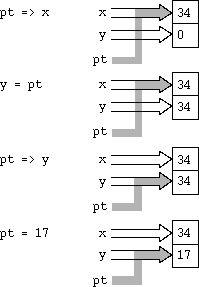
It is possible to assign a target to a pointer by using another pointer. For example:
REAL, POINTER :: pt1, pt2
...
pt2 => pt1 !legal only if pt1 has an associated target
Although this may appear to be a pointer pointing to another pointer, pt2 does not point to pt1 itself but to pt1's target. It is wrong to think of `chains of pointers', one pointing to another. Instead all pointers become associated with the same target.
Beware, of using the following statements, they are both illegal:
pt1 => 17 !constant expression is not valid target
pt2 => pt1 + 3 !arithmetic expression is not valid target
11.3.1 Dereferencing
Where a pointer appears as an alias to a variable it is automatically dereferenced; that is the value of the target is used rather than the pointer itself. For a pointer to be dereferenced in this way requires that it be associated with a target.Pointer are automatically dereferenced when they appear:
- As part of an expression.
- In I/O statements.
pt => a
b = pt !b equals a, pt is dereferenced
IF( pt<0 ) pt=0 !pt dereferenced twice
WRITE(6,*) pt !pt's target is written
READ(5,*) pt !value stored by pt's target
11.4 Pointer association status
Pointers may be in one of three possible states:- Associated - when pointing to a valid target.
- Disassociated - the result of a NULLIFY statement.
- Undefined - the initial state on declaration.
NULLIFY( list of pointers )
A pointer that has been nullified may be thought of as pointing `at nothing'.
The status of a pointer may be found using the intrinsic function:
ASSOCIATED ( list of pointers [,TARGET] )
The value returned by ASSOCIATED is either .TRUE. or .FALSE. When TARGET is absent, ASSOCIATED returns a value .TRUE. if the pointer is associated with a target and .FALSE. if the pointer has been nullified. When TARGET is present ASSOCIATED reports on whether the pointer points to the target in question. ASSOCIATED returns a value .TRUE. if the pointer is associated with TARGET and .FALSE. if the pointer points to another target or has been nullified.
It is an error to test the status of an undefined pointer, therefore it is good practice to nullify all pointers that are not immediately associated with a target after declaration.
The following example shows the use of the ASSOCIATED function and the NULLIFY statement:
REAL, POINTER :: pt1, pt2 !undefined status
REAL, TARGET :; t1, t2
LOGICAL :: test
pt1 => t1 !pt1 associated
pt2 => t2 !pt2 associated
test = ASSOCIATED( pt1 ) ! .T.
test = ASSOCIATED( pt2 ) ! .T.
...
NULLIFY( pt1 ) !pt1 disassociated
test = ASSOCIATED( pt1 ) ! .F.
test = ASSOCIATED( pt1, pt2 ) ! .F.
test = ASSOCIATED( pt2, TARGET=t2) ! .T.
test = ASSOCIATED( pt2, TARGET=t1) ! .F.
NULLIFY( pt1, pt2) !disassociated
The initial undefined status of the pointers is changed to associated by pointer assignment, there-after the ASSOCIATED function returns a value of .TRUE. for both pointers. Pointer pt1 is then nullified and its status tested again, note that more than one pointer status may be tested at once. The association status of pt2 with respect to a target is also tested. Finally both pointers are nullified in the same (last) statement.
11.5 Dynamic storage
As well as pointing to existing variables which have the TARGET attribute, pointers may be associated with blocks of dynamic memory. This memory is allocated through the ALLOCATE statement which creates an un-named variable or array of the specified size, and with the data type, rank, etc. of the pointer: REAL, POINTER :: p, pa(:)
INTEGER :: n=100
...
ALLOCATE( p, pa(n) )
...
DEALLOCATE( p, pa )
In the above example p points to an area of dynamic memory and can hold a single, real number and pa points to a block of dynamic memory large enough to store 100 real numbers. When the memory is no longer required it may be deallocated using the DEALLOCATE statement. In this respect pointers behave very much like allocatable arrays.
11.5.1 Common errors
Allocating storage to pointers can provide a great degree of flexibility when programming, however care must be taken to avoid certain programming errors:- Memory leaks can arise from allocating dynamic storage to the pointer and then re-assigning the pointer to another target:
INTEGER, POINTER :: pt(:)
...
ALLOCATE( pt(25) )
NULLIFY( pt ) !wrong
Since the pointer is the only way to reference the allocated storage (i.e. the allocated storage has no associated variable name other than the pointer) reassigning the pointer means the allocated storage can no longer be released. Therefore all allocated storage should be deallocated before modifying the pointer to it.
- It is possible to assign a pointer to a target, but then remove the target (by deallocating it or exiting a procedure to which it is local), in that case the pointer may be left `dangling':
REAL, POINTER :: p1, p2
...
ALLOCATE( p1 )
p2 => p1
DEALLOCATE( p1 ) !wrong
In the above example p2 points to the storage allocated to p1, however when that storage is deallocated p2 no longer has a valid target and its state becomes undefined. In this case dereferencing p2 would produce unpredictable results.
Programming errors like the above can be avoided by making sure that all pointers to a defunked target are nullified.
11.6 Array pointers
Pointers may act as dynamic aliases to arrays and array sections, such pointers are called array pointers. Array pointers can be useful when a particular section is referenced frequently and can save copying data. For example: REAL, TARGET :: grid(10,10)
REAL, POINTER :: centre(:,:), row(:)
...
centre => grid(4:7,4:7)
row => grid(9,:)
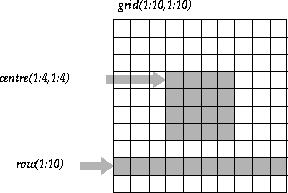
An array pointer can be associated with the whole array or just a section. The size and extent of an array pointer may change as required, just as with allocatable arrays. For example:
centre => grid(5:5,5:6) !inner 4 elements of old centre
Note, an array pointer need not be deallocated before its extent or bounds are redefined.
INTEGER, TARGET :: list(-5:5)
INTEGER, POINTER :: pt(:)
INTEGER, DIMENSION(3) :: v = (/-1,4,-2/)
...
pt => list !note bounds of pt
pt => list(:) !note bounds of pt
pt => list(1:5:2)
pt => list( v ) !illegal
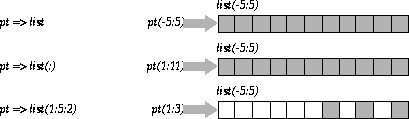
The extent (or bounds) of an array section are determined by the type of assignment used to assign the pointer. When an array pointer is aliased with an array the array pointer takes its extent form the target array; as with pt => list above, both have bounds -5:5. If the array pointer is aliased to an array section (even if the section covers the whole array) its lower bound in each dimension is 1; as with pt => list(:) above, pt's extent is 1:11 while list's extent is -5:5. So pt(1) is aliased to list(-5), pt(2) to list(-4), etc.
It is possible to associate an array pointer with an array section defined by a subscript triplet. It is not possible to associate one with an array section defined with a vector subscript, v above. The pointer assignment pt => list(1:5:2) is legal with pt(1) aliased to list(1), pt(2) aliased to list(3) and pt(3) aliased to list(5).
11.7 Derived data types
Pointers may be a component of a derived data type. They can take the place of allocatables arrays within a derived data type, or act as pointers to other objects, including other derived data types:The dynamic nature of pointer arrays can provide varying amounts of storage for a derived data type:
TYPE data
REAL, POINTER :: a(:)
END TYPE data
TYPE( data ) :: event(3)
DO i=1,3
READ(5,*) n !n varies in loop
ALLOCATE( event(i)%a(n) )
READ(5,*) event(i)%a
END DO
The number of values differs for each event, the size of the array pointer depends on the input value n. When the data is no longer required the pointer arrays should be deallocated:
DO i=1,3
DEALLOCATE( event(i)%a )
END DO
11.7.1 Linked lists
Pointers may point to other members of the same data type, and in this way create `linked lists'. For example consider the following data type: TYPE node
REAL :: item
TYPE( node ), POINTER :: next
END TYPE node
The derived type node contains a single object item (the data in the list) and a pointer next to another instance of node. Note the recursion-like property in the declaration allowing the pointer to reference its own data type.

Linked lists are a very powerful programming concept, their dynamic nature means that they may grow or shrink as required. Care must be taken to ensure pointers are set up and maintained correctly, the last pointer in the list is usually nullified. Details of how to implement, use and manipulate a linked list can be found in some of the reading material associated with these notes.
11.8 Pointer arguments
Just like other data types, pointers may be passed as arguments to procedures. There are however a few points to remember when using pointers as actual or dummy arguments:- As with other variables, actual and dummy arguments must have the same data type and rank. dummy arguments that are pointer may not have the INTENT attribute, since it would be unclear whether the intent would refer to the pointer itself or the associated target.
- Pointer arguments to external procedures require INTERFACE blocks.
When the actual argument is a pointer and the corresponding dummy argument is not, the pointer is dereferenced and it is the target that is copied to the dummy argument. On return the target takes the value of the dummy argument. This requires the actual argument to be associated with a target when the procedure is referenced.
For example:
PROGRAM prog
INTERFACE !needed for external subroutine
SUBROTINE suba( a )
REAL, POINTER :: a(:)
END SUBROUTINE suba
END INTERFACE
REAL, POINTER :: pt(:)
REAL, TARGET :: data(100)
...
pt => data
CALL suba( pt )
CALL subb( pt )
...
CONTAINS
SUBROUTINE subb( b ) !internal
REAL, DIMENSION(:) :: b !assumed shape of 100
...
END SUBROUTINE subb
END PROGRAM prog
SUBROUTINE suba( a ) !external subroutine
REAL, POINTER :: a(:) !a points to data
...
END SUBROUTINE suba
It is not possible for a non-pointer actual argument to correspond with a pointer dummy argument.
11.9 Pointer functions
Functions may return pointers as their result. This is most useful where the size of the result depends on the function's calculation. Note that:- The result must have the POINTER attribute.
- The returning function must have a valid target or have been nullified.
- Pointer results from external procedures require INTERFACE blocks.
INTERFACE
FUNCTION max_row ( a )
REAl, TARGET :: a(:,:)
REAL, POINTER :: max_row(:)
END FUNCTION max_row
END INTERFACE
REAL, TARGET :: a(3,3)
REAL, POINTER :: p(:)
...
p => max_row ( a )
...
FUNCTION max_row ( a ) !external
REAL, TARGET :: a(:,:)
REAL, POINTER :: max_row(:) !function result
INTEGER :: location(2)
location = MAXLOC( a ) !row and column of max value
max_row => a(location(1),:) !pointer to max row
END FUNCTION max_row
Here the external function max_row returns the row of a matrix containing the largest value. The pointer result is only allowed to point to the dummy argument a because it is declared as a target, (otherwise it would have been a local array and left the pointer dangling on return). Notice the function result is used on the right hand side of a pointer assignment statement. A pointer result may be used as part of an expression in which case it must be associated with a target.
11.10 Exercises
- Write a declaration statement for each of the following pointers and their targets:
(a) A pointer to a single element of an array of 20 integers.
(b) A pointer to a character string of length 10.
(c) An array pointer to a row of a 10 by 20 element real array.
(d) A derived data type holding a real number three pointers to neighbouring nodes, left, right and up (this kind of derived data structure may be used to represent a binary tree).
- For the pointer and target in the following declarations write an expression to associate the pointer with:
(a) The first row of the target.
(b) A loop which associates the pointer with each column of the target in turn.
REAL, POINTER :: pt(:)REAL, TARGET, DIMENSION(-10:10, -10:10) :: a - Write a program containing an integer pointer and two targets. Nullify and report the initial status of the pointer (using the ASSOCIATED intrinsic function). Then associate the pointer with each of the targets in turn and output their values to the screen. Finally ensure the pointer ends with the status `not currently associated'.
- Write a program containing a derived data type. The data type represents different experiments and should hold the number of reading taken in an experiment (an integer) and values for each of the readings (real array pointer).
Read in the number and values for a set of experimental readings, say 4, and output their mean. Deallocate all pointers before the program finishes.
- Write an internal function that takes a single rank one, integer array as an argument and returns an array pointer to all elements with non-zero values as a result. The function will need to count the number of zero's in the array (use the COUNT intrinsic), allocate the required storage and copy each non-zero value into that storage. Write a program to test the function.
[Next] [Previous] [Top]
All documents are the responsibility of, and copyright, © their authors and do not represent the views of The Parallel Computer Centre, nor of The Queen's University of Belfast.
Maintained by Alan Rea, email A.Rea@qub.ac.uk Generated with CERN WebMaker
Source: https://www.adt.unipd.it/corsi/Bianco/www.pcc.qub.ac.uk/tec/courses/f90/stu-notes/F90_notesMIF_12.html
0 Response to "Is the Data in Structue Type in Fortran Continuous in Memeory"
Post a Comment